
AI Hiring
Best AI Interview Assist Tools for Hiring Managers in 2026
Compare the best AI interview assist tools for hiring managers in 2026. Six platforms reviewed by category, evaluation depth, and where each saves the most hiring manager time.
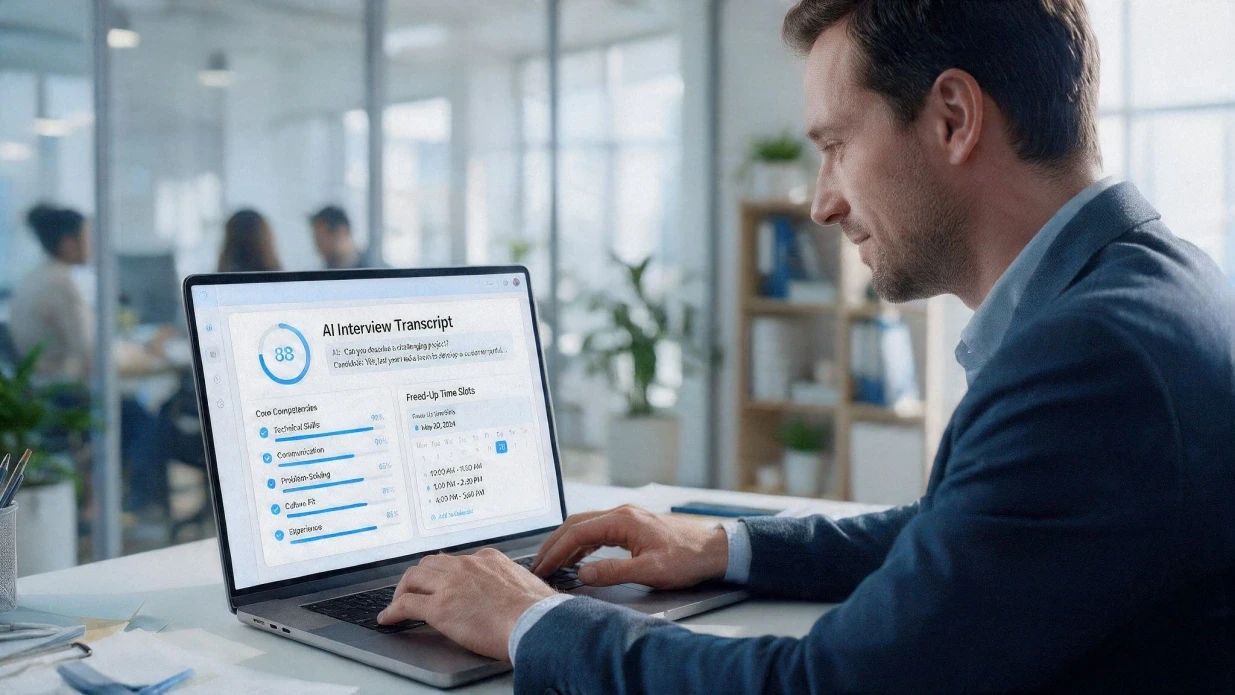
The average corporate role consumes 23 hours of interviewer time across the panel before a hire is made, according to LinkedIn's 2026 hiring data.
Most of that time belongs to senior staff, making the hourly cost significant before a single offer is extended.
According to SHRM's 2026 State of the Workplace survey, 43% of HR leaders now use some form of AI in their interview process, up from 17% in 2023.
That shift is largely driven by hiring managers and TA leaders who found that the interview stage, not sourcing, is where the most recoverable time and quality loss sits.
This article covers the best AI interview assist tools and AI interview evaluation tools for hiring managers specifically, what each category does, and which AI-powered interview assist fits which stage of the interview process.
Quick Summary
The best AI interview assist tools for hiring managers in 2026 are Zeko AI, BrightHire, Metaview, Greenhouse, Willo, and GoodTime.
Each addresses a different stage of the hiring manager's involvement, from removing early-round sessions entirely to improving evaluation quality in live panels.
The right tool depends on where hiring manager time is being spent most expensively: early-round screening, live panel documentation, post-interview calibration, or scheduling coordination.
The best AI tools for interviewers address one of these stages specifically, not all of them equally.
What Hiring Managers Actually Need From AI Interview Tools
The interview stage sits differently for hiring managers than for recruiters. A recruiter manages workflow and pipeline. A hiring manager shows up to evaluate and decide.
AI interview software for hiring teams must therefore serve different needs from recruiter-facing tools. Hiring manager AI interview tools that perform well are often purpose-built for evaluation depth rather than pipeline management.
Three things consistently come up when hiring managers describe what they need from an AI interview assist tool:
Less time in early-round sessions: First-round screens consume the most time relative to their evaluation value. A hiring manager spending four hours weekly on first-round screens for three roles loses that time to the work the role was created to do.
Better evaluation signal from the sessions they do attend: Even experienced interviewers recall candidate answers inconsistently when scoring two or more hours after the session.
Research cited by SHRM shows that interviewers using live transcription tools recall 34% more of a candidate's answers correctly at scoring time compared to those relying on manual notes.
Calibration that holds across panels: When four hiring managers evaluate the same role with different questions and mental scorecards, the shortlist reflects panel variance more than candidate quality.
Structured calibration tools close that gap without requiring alignment meetings before every interview.
Understanding what an AI interview assistant for hiring managers actually provides, rather than what it provides for recruiters, is the clearest starting point before evaluating any of the tools below.
6 Best AI Interview Assist Tools for Hiring Managers in 2026
1. Zeko AI
What it does:
Zeko AI conducts live adaptive AI interviews without a human interviewer present. Avya, Zeko AI's interview agent, adjusts follow-up questions in real time based on what each candidate says, evaluating behavioral competencies and role-specific functional depth simultaneously.
The output is a verified capability report with dimension-level scores, backed by specific evidence from the conversation, that writes directly into the connected ATS across Workday, SAP SuccessFactors, Darwinbox, Greenhouse, Lever, Keka, and 12 more platforms.
Best for:
Enterprise and GCC teams where early-round interviewer time is the most significant documented cost.
Zeko AI removes the first structured evaluation round from the hiring manager's schedule entirely, conducting it autonomously to a higher consistency standard than ad-hoc panel interviews typically achieve.
Standout feature:
Research on how an AI interview copilot reduces mis-hires in final rounds shows that hiring managers who receive structured evaluation evidence before the panel stage make faster decisions with fewer post-hire reversals.
Trusted by 150-plus enterprises including Infosys, Schneider Electric, Persistent Systems, and Nagarro. SOC2 Type II certified, GDPR compliant, and ISO 27001 certified.
2. BrightHire
What it does:
BrightHire operates as a live interview copilot during human-led video sessions. It transcribes the conversation in real time and surfaces follow-up question prompts when a competency area is left unexplored.
Structured scorecard inputs are auto-generated after each session, removing the post-interview documentation burden from the interviewer.
Best for:
Engineering and functional hiring managers who conduct live panels and produce inconsistent post-interview documentation. BrightHire improves the quality of evaluation output from sessions the hiring manager attends rather than reducing the number of sessions they attend.
Standout feature:
Shared interview highlights let each panelist clip specific moments from the recorded session and attach them to scorecard criteria. Consequently, debrief discussions focus on documented evidence from the conversation rather than competing impressions of what was said.
3. Metaview
What it does:
Metaview captures what is actually said across all interviews and surfaces patterns that scorecard submissions do not reveal.
It identifies where competency criteria are applied inconsistently across interviewers and where questions are consistently skipped.
Best for:
TA leaders and hiring managers overseeing multiple panels simultaneously. Metaview is specifically strong where scorecards look structured but conceal significant variation in what was actually evaluated from session to session.
Standout feature:
Natural language search across all captured sessions: a hiring manager can query what candidates said about specific domains or competencies across an entire interview program without re-watching sessions.
The insight surfaces from the conversation data, not from what panelists chose to record.
4. Greenhouse
What it does:
Greenhouse is a structured hiring ATS that enforces competency-based evaluation discipline across panels.
Its interview kit enforcement requires every interviewer to score each candidate against defined criteria before the pipeline advances, removing vague overall impressions in place of structured documentation.
Best for:
Structured hiring teams where evaluation inconsistency is a governance concern rather than a time concern.
Greenhouse does not reduce the number of interviews. It ensures the interviews that are conducted produce defensible, comparable evidence.
Standout feature:
For teams where panel compliance is low, the question of whether an AI interview assistant can replace scorecards is less pressing than whether scorecards are being completed at all. Greenhouse enforces that discipline as the highest-ROI starting point.
5. Willo
What it does:
Willo removes hiring manager involvement from early-funnel video screening through asynchronous candidate-led sessions. Candidates record responses at a time that suits them. Hiring managers review AI-generated summaries and searchable transcripts rather than attending live screening sessions.
Best for:
Enterprise teams where hiring managers are pulled into early-stage screening because no structured alternative exists.
Willo replaces that involvement with a reviewable async layer that produces more consistent evaluation output than ad-hoc early-round calls.
Standout feature:
AI-generated candidate summaries mean hiring managers can review 20 candidate sessions in the time it would previously have taken to conduct three live screening calls.
The review happens on their schedule rather than against a shared calendar.
6. GoodTime
What it does:
GoodTime is an interview scheduling intelligence platform that coordinates panel availability, sends automated reminders, handles reschedule requests, and optimises multi-round panel scheduling across complex interviewer calendars without coordinator involvement at each step.
Best for:
Teams where multi-panel interview scheduling is consuming significant recruiting coordinator or hiring manager time. GoodTime's agentic scheduling layer handles the coordination so hiring managers receive calendar invitations rather than scheduling requests.
Standout feature:
Intelligent panelist selection: GoodTime surfaces the most appropriate interviewers for each stage based on availability, role expertise, and calibration history.
The panel composition improves without additional coordination overhead, rather than defaulting to whoever responds first.
How These Tools Compare
The table below maps each tool by category, what it does for hiring managers, and where it fits best.
Tool | Category | What it does for hiring managers | Best fit |
Zeko AI | Adaptive AI evaluation | Conducts the structured first-round interview autonomously, delivering dimension-level scores | Enterprise and GCC teams where early-round HM time is the primary cost |
BrightHire | Live interview copilot | Transcribes live sessions, surfaces follow-up prompts, auto-generates scorecard inputs | Engineering and functional panels needing better documentation without format change |
Metaview | Conversation analytics | Captures and analyses what was actually said versus what was recorded on scorecards | TA leaders needing cross-panel evaluation quality visibility at scale |
Greenhouse | Structured scoring | Enforces competency-based scoring before pipeline advancement, prevents vague submissions | Structured hiring teams prioritising defensible, comparable evaluation decisions |
Willo | Async video screening | Removes hiring manager from early-funnel video screening entirely through candidate-led async sessions | Enterprise teams screening at volume where scheduling coordination is the bottleneck |
GoodTime | Scheduling intelligence | Coordinates panel availability, sends reminders, handles reschedules autonomously | Teams where multi-panel interview scheduling is consuming significant coordinator time |
How to Choose the Right AI Interview Assist Tool
The starting point, when evaluating any interview assist AI platform or AI interview copilot tools, is identifying where hiring manager time is disappearing most consistently, not which platform has the most comprehensive feature set.
If early-round sessions are consuming most of the time: Zeko AI removes the first structured evaluation round from the hiring manager's schedule. Willo removes early-funnel screening more broadly for roles where async video is appropriate.
If the quality of live panel sessions is the gap: BrightHire improves documentation and recall quality for panels the hiring manager attends. Metaview surfaces what is actually happening across multiple panels simultaneously.
If scorecard compliance and calibration are the problem: Greenhouse's structured evaluation enforcement is the highest-ROI starting point before layering on more sophisticated AI tools.
If scheduling coordination is consuming coordinator or hiring manager time: GoodTime handles multi-panel scheduling autonomously, removing the back-and-forth that typically takes two to three days per interview cycle.
For teams evaluating how AI interview tools affect inter-panel alignment specifically, the five ways an AI interview copilot improves recruiter alignment covers the mechanisms through which structured evaluation evidence changes how hiring managers and recruiters reach decisions together.
Teams with documented interview-to-offer drop-off problems will also find that the evaluation stage is where most drop-off occurs, rather than at the offer stage, making the interview assist layer the most direct intervention available.
Wrapping Up
The best AI interview assist tools for hiring managers in 2026 are not interchangeable. A live copilot that improves note quality does not reduce the number of sessions attended.
An async screening tool that removes early-funnel involvement does not improve the quality of panel evaluation.
Matching the tool to the specific problem, whether that is time in early rounds, documentation quality, or calibration consistency, is what produces measurable improvement in both hiring manager efficiency and evaluation quality.
Zeko AI is built for the evaluation layer specifically: adaptive AI interviews that give hiring managers a structured, comparable capability report before the panel stage, rather than a stack of unstructured notes to reconcile afterward.
FAQs
1. What are the best AI interview assist tools for hiring managers in 2026?
The best AI interview assist tools for hiring managers in 2026 are Zeko AI for adaptive structured evaluation, BrightHire for live panel documentation, Metaview for cross-panel analytics, Greenhouse for scorecard enforcement, Willo for async early-stage screening, and GoodTime for intelligent panel scheduling and coordination.
2. How do AI interview assist tools help hiring managers specifically?
AI interview assist tools help hiring managers in three specific ways: reducing time spent in early-round screening sessions, improving the quality and accuracy of evaluation documentation in live panels, and enforcing calibration consistency across multiple interviewers assessing the same role and competency framework.
3. What is the difference between an AI interview copilot and an AI interview platform?
An AI interview copilot assists a human interviewer by transcribing, prompting follow-up questions, or auto-generating scorecard inputs. An AI interview platform like Zeko AI conducts the interview autonomously without a human present, producing structured evaluation output rather than assisting a human-led session.
4. How much hiring manager time do AI interview tools save?
Research from LinkedIn and SHRM puts average corporate panel time at 23 hours per hire across all interviewers. AI tools that remove early-round involvement or reduce documentation time typically recover three to five hours per open role per cycle, with the largest savings at the first-round evaluation stage.
5. What are the best AI tools for recruitment, onboarding, and people analytics in HR?
For AI interview evaluation, Zeko AI leads for adaptive AI-led interviews. For live panel intelligence, BrightHire leads. For cross-panel analytics, Metaview leads. For people analytics connecting evaluation decisions to hiring outcomes, Visier provides quality-of-hire attribution. For onboarding, dedicated HRIS platforms handle that stage separately.
6. What are the top AI recruiting tools for 2026?
Among the top AI recruiting tools with specific hiring manager value, Zeko AI leads for structured evaluation, BrightHire for live interview copilot capability, Metaview for interview analytics, and GoodTime for scheduling intelligence. Each addresses a different part of the interview process.
Act Now
Build a Consistent, Audit-Ready Hiring Process
Standardize interviews across geographies and improve hiring quality with Zeko's AI platform.
Trusted by 150+ enterprises
SOC2 · GDPR · ISO27001
4.8/5 Average Candidate Rating
Act Now
Build a Consistent, Audit-Ready Hiring Process
Standardize interviews across geographies and improve hiring quality with Zeko's AI platform.
Trusted by 150+ enterprises
SOC2 · GDPR · ISO27001
4.8/5 Average Candidate Rating
Act Now
Build a Consistent, Audit-Ready Hiring Process
Standardize interviews across geographies and improve hiring quality with Zeko's AI platform.
Trusted by 150+ enterprises
SOC2 · GDPR · ISO27001
4.8/5 Average Candidate Rating