
Recruitment Technology
Best End-to-End Agentic Recruitment Platforms in 2026 (Beyond Point Solutions)
Compare 6 agentic recruitment platforms in 2026. What separates genuine automation from point solutions, and which platforms lead each funnel stage
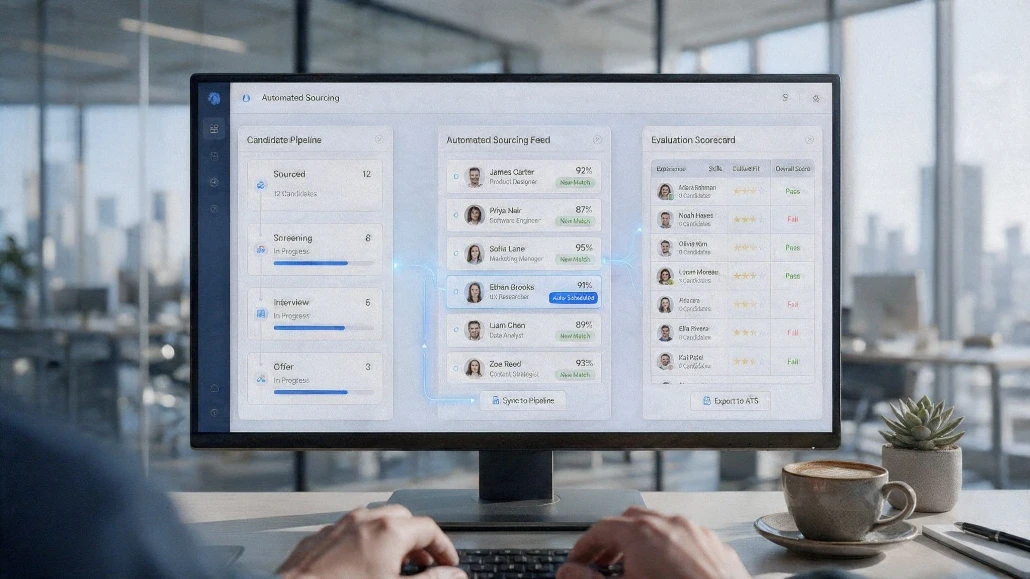
Most TA teams in 2026 do not have an AI problem. They have a fragmentation problem.
A sourcing tool here. A scheduling bot there. A video screening layer bolted on. An ATS in the middle holding none of it together cleanly.
According to Korn Ferry research cited in Recruiterflow's 2026 State of AI in Recruiting, 52% of talent leaders plan to add autonomous agents to their teams in 2026.
Gartner's own projections put autonomous AI decision-making at 15% of day-to-day work by 2028, up from essentially zero in 2024.
The question is not whether to adopt autonomous recruiting tools. It is whether the specific platforms a team is considering are genuinely agentic or simply point solutions with a more sophisticated label.
Quick Summary
The best agentic recruitment platforms in 2026 include hireEZ and Findem for autonomous sourcing, Humanly for candidate journey automation, Zeko AI for adaptive structured evaluation, Phenom for talent experience orchestration, and Beamery for long-term talent lifecycle management.
What separates them from point solutions is whether the system moves work forward autonomously or waits for a human to trigger the next action. A point solution automates one step and stops. A genuine agent carries the work forward.
What Makes a Recruitment Platform Genuinely Agentic
The word agentic has accumulated considerable marketing weight in 2026. Vendors apply it to features that are, on closer inspection, automated responses to triggers rather than genuine agentic AI recruiting platform capabilities.
A genuinely agentic recruitment platform meets three tests:
It executes across steps without per-step prompting: The agent receives a goal and carries it forward through multiple stages without a recruiter approving each move. Sourcing, qualification, and outreach happen as a connected sequence.
It adapts based on what it learns: The agent adjusts its approach based on outcomes. If outreach to one candidate segment produces lower response rates, the system recalibrates its strategy. A static automation does not do this.
It integrates across systems, not just within one: Genuine agentic recruitment automation connects sourcing data, evaluation output, and ATS records without manual handoffs between platforms.
Understanding how agentic recruitment automation differs from rule-based RPA is the clearest way to pressure-test whether a vendor's claims hold up under scrutiny.
Why Point Solutions Create the Problem They Claim to Solve
A point solution automates one step in a sequence and hands the result to a human, who hands it to the next tool. The recruiter becomes the integration layer.
TA teams still shortlisting profiles manually after deploying three or four AI tools is the most common symptom of fragmentation. Each tool improved its specific step. The work between steps, where recruiter time actually disappears, remained manual.
End-to-end agentic recruitment platforms orchestrate the handoffs between stages rather than optimising individual stages in isolation.
The agent knows where a candidate is in the process, what information has already been captured, and what the next step is, because it has visibility across the full sequence.
That orchestration capability is what distinguishes genuine end-to-end recruitment automation from the broader category of AI recruiting tools. It is also why the evaluation criteria here differ significantly from a standard tool comparison.
6 Best Agentic Recruitment Platforms in 2026
The platforms below are organised by the funnel stage where their agentic hiring software capability is strongest. Most enterprise TA teams combine two or three layers rather than expecting a single platform to execute all of them equally well.
1. hireEZ , Agentic Outbound Sourcing
What it does:
hireEZ's EZ Agent autonomously discovers, qualifies, and initiates outreach to passive candidates across 800 million-plus profiles from open-web sources, ATS databases, and talent pools.
The agent recalibrates its approach based on response rate signals without manual intervention between steps.
Best for:
Outbound-first talent acquisition teams that need a focused agentic sourcing and screening platform for hard-to-fill technical and specialist roles without managing multiple tools simultaneously.
Standout feature:
ResumeSense fake candidate detection and diversity sourcing filters are built into the agentic sourcing workflow.
The pipeline that surfaces is both verified and DEI-calibrated without a separate manual pass.
2. Findem , Attribute-Based Sourcing Intelligence
What it does:
Findem approaches sourcing through attribute-based search rather than keyword matching.
Its agents search across structured and unstructured data to surface candidates based on career attributes, behavioural signals, and growth patterns rather than job title proximity.
The platform executes and adapts sourcing strategy autonomously, identifying candidates that traditional search consistently misses and continuously refining its approach based on what the data reveals.
Best for:
Strategic TA teams that have outgrown keyword-based sourcing and need a system that can reason about candidate potential rather than match on explicit role history.
Standout feature:
Autonomous sourcing strategy adaptation: Findem adjusts its candidate discovery approach based on pipeline outcomes rather than waiting for a recruiter to revise the search parameters.
3. Humanly , End-to-End Candidate Journey Automation
What it does:
Humanly automates the full candidate journey from first contact through screening, scheduling, and interview summarisation.
The platform operates across chat, SMS, email, phone, and video, integrating with most enterprise ATS platforms for two-way data sync.
Best for:
Mid-market and enterprise teams at high volume across frontline, healthcare, logistics, and hourly roles where speed-to-first-interview is the defining constraint and DEI-conscious automation is a procurement requirement.
Standout feature:
The agentic handoff from screening to scheduling is built into a single workflow. A candidate who qualifies automatically progresses to interview booking without a recruiter manually approving the transition.
4. Zeko AI , Adaptive AI Evaluation
What it does:
Zeko AI's interview agent, Avya, conducts live adaptive interviews that adjust follow-up questions in real time based on what each candidate says.
Every session evaluates behavioral competencies and role-specific functional depth simultaneously, without a human interviewer present.
Every session produces a verified capability report with dimension-level scores. The report writes directly into the connected ATS across Workday, SAP SuccessFactors, Darwinbox, Greenhouse, Lever, Keka, and 12 more platforms.
Best for:
Enterprise and GCC teams where evaluation inconsistency across panels is the documented constraint. For structured GCC talent acquisition at scale, Zeko AI closes the gap between a screened candidate and a genuinely assessed one.
Standout feature:
Adaptive questioning that follows the candidate's actual answers rather than a fixed sequence. Strong responses trigger deeper probing. Vague answers prompt clarification. The agent maps genuine capability rather than scripted readiness.
Trusted by 150-plus enterprises including Infosys, Schneider Electric, Persistent Systems, and Nagarro. SOC2 Type II certified, GDPR compliant, and ISO 27001 certified.
5. Phenom , Talent Experience Orchestration
What it does:
Phenom orchestrates the candidate experience across career site, CRM, and ATS through personalised AI-driven interactions. Its agents serve tailored job recommendations, automate early-stage screening conversations, and keep pipelines engaged from first visit through offer.
Best for:
Employer brand-led enterprises with high career site traffic where converting visitors to applicants is the primary constraint and brand consistency across every candidate touchpoint is a governance requirement.
Standout feature:
Real-time personalisation at scale: the agent adjusts what a candidate sees based on browsing behaviour, previous interactions, and profile data, creating a consistent, relevant experience across every touchpoint without manual curation per segment.
6. Beamery , Talent Lifecycle Intelligence
What it does:
Beamery extends beyond reactive recruitment into proactive talent lifecycle management.
Its agents orchestrate skills-based matching, talent nurture, and workforce planning across internal and external pools simultaneously, surfacing future talent needs alongside current open roles.
Best for:
Enterprises where the immediate fill rate matters less than the quality and diversity of the pipeline being built for the next 12-24 months.
Beamery suits organisations that want a single intelligence layer across sourcing, nurture, and internal mobility.
Standout feature:
Skills-based orchestration treats internal employees and external candidates through the same matching framework.
A role that cannot be filled externally in time can surface an internal candidate the team had no visibility into, without a separate process.
How These Platforms Compare
The table below maps each platform by the funnel stage it covers, its primary agentic capability, and the context it is best suited to.
Platform | Funnel Layer | Agentic Capability | Best Fit |
hireEZ | Sourcing | Autonomous discovery, qualification, and outreach across 800M+ profiles | Outbound-first TA teams scaling passive candidate pipelines |
Findem | Sourcing and pipeline intelligence | Attribute-based search and autonomous sourcing strategy adaptation | Strategic TA teams moving beyond keyword-based sourcing |
Humanly | Screening and scheduling | End-to-end candidate journey automation across chat, SMS, email, and video | Mid-market and enterprise teams at high volume across frontline roles |
Zeko AI | Evaluation | Adaptive AI interviews that adjust per candidate with full ATS write-back | Enterprise and GCC teams needing consistent structured evaluation at scale |
Phenom | Talent experience | Personalised career site, CRM, and pipeline orchestration across the full funnel | Employer brand-led enterprises converting career site traffic into qualified pipeline |
Beamery | Talent lifecycle | Skills-based orchestration across sourcing, nurture, and workforce planning | Enterprises running long-term talent strategy across internal and external pools |
How to Choose the Right Agentic Recruitment Platform
Before comparing platforms, map the specific point in the recruitment workflow where human time is disappearing most predictably. That layer is where AI-driven recruitment workflow automation delivers the clearest return first.
Top-of-funnel sourcing is the constraint: hireEZ for outbound volume, Findem for attribute-based intelligence. Both operate autonomously but suit different sourcing philosophies.
Candidate engagement and scheduling is the bottleneck: Humanly's end-to-end candidate journey automation handles this most comprehensively for volume roles.
Evaluation consistency across panels and locations is the documented problem: Zeko AI's adaptive evaluation layer addresses this specifically, producing comparable structured evidence for every candidate regardless of which panel or location would have been involved.
Career site conversion and talent brand experience is the gap: Phenom's orchestration across career site, CRM, and ATS is the strongest option for employer brand-led enterprise environments.
Long-term talent strategy and internal mobility are the priority: Beamery's lifecycle intelligence layer is built for this use case specifically.
As 2026 AI and HR trends research consistently shows, the most effective enterprise TA stacks combine two or three agentic layers. Sourcing, evaluation, and talent experience are genuinely different problems that benefit from purpose-built agents rather than generalised coverage.
For teams calculating where agentic investment returns the most in year one, the analysis of how AI interview software reduces cost per hire consistently points to the evaluation and scheduling layers as the highest-ROI starting points.
Wrapping Up
The best agentic recruitment platforms in 2026 earn that label by connecting steps, adapting to outcomes, and moving candidates through the process without a human bridging each handoff.
The TA teams seeing the strongest returns are not those who deployed the most tools.
They are those who identified where the process breaks between steps and chose platforms that close that specific gap autonomously.
Zeko AI handles the evaluation stage of that stack, with adaptive AI interviews that produce structured, comparable capability evidence and feed it directly into the enterprise ATS without manual reconciliation.
FAQs
1. What are the best agentic recruitment platforms in 2026?
The strongest agentic recruitment platforms by funnel stage are hireEZ and Findem for autonomous sourcing, Humanly for end-to-end candidate journey automation, Zeko AI for adaptive structured evaluation, Phenom for talent experience orchestration, and Beamery for long-term talent lifecycle management.
2. What is the difference between an agentic recruitment platform and a point solution?
A point solution automates one step and hands the result to a human. An agentic platform executes across multiple steps without per-step prompting, adapts based on outcomes, and integrates across systems without manual handoffs. The recruiter becomes a checkpoint rather than the integration layer.
3. What makes a recruitment platform genuinely agentic?
Three tests: whether it executes multi-step workflows without per-step prompting, whether it adapts based on outcomes rather than fixed logic, and whether sourcing, evaluation, and ATS data connect automatically. Meeting only one or two makes a platform a sophisticated automation, not a genuine agent.
4. What are the best AI tools for recruitment, onboarding, and people analytics in HR?
For agentic sourcing, hireEZ and Findem lead. For structured evaluation, Zeko AI leads for adaptive AI interviews. For talent experience and pipeline management, Phenom and Beamery address different enterprise contexts. For people analytics connecting talent decisions to workforce outcomes, Visier provides attribution depth that recruitment-focused platforms do not cover.
5. What are the top AI recruiting tools for 2026?
Among the top AI recruiting tools with genuine agentic capability, hireEZ leads for outbound sourcing, Zeko AI for structured interview evaluation, Humanly for end-to-end candidate engagement, and Phenom for talent experience orchestration. Each addresses a different funnel stage.
6. How do I evaluate whether an AI recruitment platform is truly agentic?
Ask three questions in any vendor demo: can the agent complete a multi-step workflow without human approval at each step, how does it adapt when an approach stops working, and what happens at the ATS handoff. Platforms that struggle with any of these are automations with agentic branding.
Act Now
Build a Consistent, Audit-Ready Hiring Process
Standardize interviews across geographies and improve hiring quality with Zeko's AI platform.
Trusted by 150+ enterprises
SOC2 · GDPR · ISO27001
4.8/5 Average Candidate Rating
Act Now
Build a Consistent, Audit-Ready Hiring Process
Standardize interviews across geographies and improve hiring quality with Zeko's AI platform.
Trusted by 150+ enterprises
SOC2 · GDPR · ISO27001
4.8/5 Average Candidate Rating
Act Now
Build a Consistent, Audit-Ready Hiring Process
Standardize interviews across geographies and improve hiring quality with Zeko's AI platform.
Trusted by 150+ enterprises
SOC2 · GDPR · ISO27001
4.8/5 Average Candidate Rating