
AI Hiring
How AI Interview Software Affects Cost Per Hire (2026 Guide)
Understand exactly how AI interview software reduces cost per hire in 2026, which cost layers it affects, realistic savings ranges, and what prevents teams from realising them.
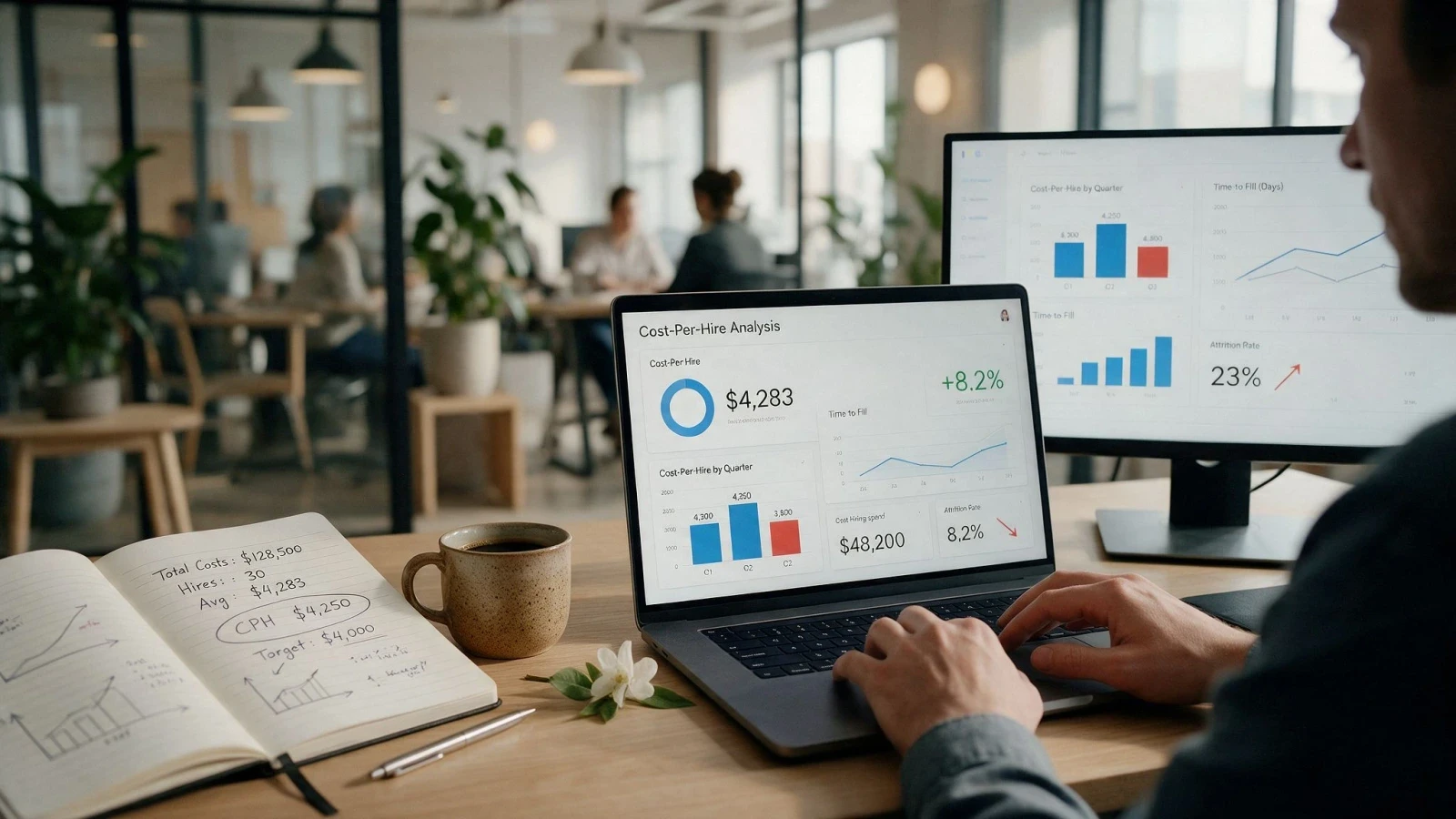
Cost per hire is one of the most cited metrics in talent acquisition and one of the least understood. Most teams know their headline number. Fewer know which specific activities drive it or which can actually be reduced.
According to Aptitude Research, via a 2026 AI recruiting analysis, 65% of companies using AI improved cost per hire, compared to 39% not using AI.
That is a meaningful gap. The gains are, however, concentrated in teams that combine AI adoption with structured process change, not those that layer AI on top of an unchanged workflow.
This article covers exactly how AI interview software cost per hire dynamics work, where the savings come from, and what gets in the way.
Quick Summary
AI interview software cost per hire reduction is real but conditional. Teams with good change management and structured implementation see 20-25% reductions. Teams that deploy AI without process discipline see 5-10%.
The difference is not the software. It is whether the team changes how it works alongside the software.
This article covers where cost per hire comes from, which layers AI interview software actually affects, and what prevents teams from seeing the full reduction.
Where Cost Per Hire Actually Comes From
Cost per hire follows a simple formula: total internal plus external recruiting costs divided by number of hires. What makes it hard to control is that costs accumulate across every stage.
Most hiring teams think of cost per hire as a sourcing problem. Job board spend and agency fees are the most visible line items.
In practice, however, the larger share sits in internal labor: recruiter hours spent screening resumes, scheduling interviews, coordinating panels, and re-running searches when strong candidates drop out.
AI interview software does not reduce job board fees. It reduces the labor-intensive stages between sourcing and offer, which is where internal cost per hire actually accumulates.
Most teams discover this when they first evaluate an AI interview platform and realise the ROI case rests on labor reduction, not sourcing spend.
The four stages where internal cost per hire accumulates most are screening, scheduling, panel evaluation, and mis-hire replacement. AI interview software cost per hire reduction comes from all four.
How AI Interview Software Affects Each Cost Layer
Screening: replacing high-volume manual review
Initial screening is the single largest internal cost in most hiring processes. Reducing AI screening cost per hire starts here.
A recruiter reviewing 200 applications at three minutes each spends ten hours on one role before a single qualified candidate is identified.
AI interview software replaces this with structured, automated screening sessions. Each candidate completes the same evaluation. The recruiter reviews structured output in minutes rather than hours. The screening time reduction is therefore immediate and directly measurable.
Screening time reductions of 60-75% per role are consistently reported for high-volume roles, compounding significantly across ten simultaneous open positions.
That kind of scale is where high-volume interview software shifts from a time-saving tool to a structural change in how recruiter capacity is deployed.
Scheduling: eliminating coordination overhead
Interview scheduling is the most underestimated cost driver in hiring.
Interview automation cost savings from eliminating coordination are immediate. A single interview requiring two rounds of back-and-forth consumes up to an hour of combined calendar time.
AI interview software eliminates this for the first structured evaluation round. Candidates complete the session at a time that suits them. No coordination is required. The recruiter receives structured output without having been present in the session.
Across a team running 50 interviews per week, the scheduling saving alone recovers several recruiter hours weekly.
This is a significant AI recruitment cost reduction and a meaningful contributor to AI interview software cost per hire improvement even before evaluation quality is considered.
Panel time: protecting senior interviewer hours
The most expensive hour in a hiring process is a senior engineer or functional expert spending 60 minutes interviewing a candidate who should have been screened out earlier.
AI interview software shifts structured first-round evaluation to an automated session. Senior interviewers see only candidates who have cleared a structured threshold.
The number of senior interviewer hours per hire drops, and those hours concentrate on candidates who are genuinely worth the panel's time.
This is where AI interview software ROI is most defensible to finance, because the saving is in the most expensive labor the team has: senior subject-matter expert time.
Mis-hires: reducing the most expensive cost of all
A mis-hire at engineer level costs between 100% and 150% of annual salary according to SHRM's 2025 Benchmarking data. That single figure can dwarf every other cost per hire saving a team achieves in a given quarter.
AI interview software reduces mis-hires by improving evaluation consistency. When every candidate is assessed against the same structured rubric, the shortlist reflects demonstrated capability rather than interviewer impression.
Candidates most likely to underperform are consequently more likely to be identified before offer.
The AI hiring software cost reduction from fewer mis-hires is harder to measure in real time but becomes the most significant line item when tracked over 12 months across a team making 50 or more hires per year.
What the Realistic Cost Reduction Looks Like
Vendor claims of 30-40% cost per hire reduction should be treated with scepticism. They typically reflect best-case deployments at high volume with full change management support. First-year results are generally more modest.
The more reliable framework, cited in Agenticinterviewer.com's 2026 ROI benchmark, breaks the reduction into three tiers:
5-10%: AI deployed without process change. Recruiters use the tool alongside existing workflows rather than replacing manual stages.
20-25%: AI deployed with structured implementation and recruiter adoption. Manual screening replaced, scheduling automated, senior panel time protected.
30-40%: AI deeply embedded across sourcing, screening, scheduling, and evaluation. Typically requires 18-24 months of sustained TA leadership commitment.
The realistic target for most enterprise teams in the first year is 15-25%. Communicating honest AI interview platform cost savings expectations before deployment prevents the abandonment that follows inflated claims.
Internal proposals that anchor to the 20-25% figure are more credible and more likely to clear finance approval.
A detailed AI interview business case built on conservative assumptions holds up better when results are reviewed at the six-month mark.
What Prevents Teams From Realising the Savings
The gap between 5% and 25% reduction is almost always explained by the same failure patterns.
Layering AI on top of existing workflows: If recruiters continue reviewing every candidate manually after the AI session, the tool adds a step rather than replacing one. The cost saving requires the manual step to be removed.
Low candidate completion rates: An AI interview that 40% of candidates abandon does not reduce cost per hire. It creates a secondary drop-off problem. Candidate experience design matters as much as evaluation quality.
No structured scoring rubric: AI interview software without a defined competency framework produces output that recruiters do not trust and therefore do not use. The evaluation must be configured to the role.
Treating AI as a sourcing tool: Cost per hire reductions come primarily from the evaluation and scheduling layers, not from sourcing. Teams that deploy AI at the top of the funnel without changing interview structure see the smallest gains.
Addressing these four patterns before deployment is ultimately the most reliable predictor of whether a team reaches 20-25% or stays at 5-10%.
How Zeko AI Affects Cost Per Hire
The cost of hiring with AI tools like Zeko AI is most accurately measured across three layers: screening time, scheduling coordination, and panel evaluation hours. Additionally, Zeko AI addresses mis-hire risk through evaluation consistency.
Avya, Zeko AI's interview agent, conducts adaptive AI-led interviews that replace the first structured evaluation round entirely.
The session adjusts follow-up questions in real time per candidate, producing a verified capability report with dimension-level scores.
The report writes directly into the connected ATS, covering Workday, SAP SuccessFactors, Darwinbox, Greenhouse, Lever, Keka, and 12 more platforms. Senior interviewers consequently receive structured, comparable evidence without spending time in early-round sessions.
In benchmarks across enterprise deployments in India, Zeko AI consistently produces the strongest cost per hire impact in roles where structured first-round evaluation is the bottleneck, specifically technical, functional, and lateral hiring at scale.
Comparisons of enterprise AI recruitment software in India place Zeko AI's evaluation layer as the primary driver of first-year CPH reduction in structured hiring contexts.
For GCC teams, evaluation inconsistency across panels and geographies drives re-interview cycles that inflate cost per hire.
Structured AI hiring software for GCCs shows the highest CPH impact when it replaces these inconsistent manual evaluation rounds.
Trusted by 150-plus enterprises including Infosys, Schneider Electric, Persistent Systems, and Nagarro. SOC2 Type II certified, GDPR compliant, and ISO 27001 certified.
Wrapping Up
AI interview software cost per hire reduction comes primarily from screening labor, scheduling overhead, senior panel time, and improved evaluation consistency that reduces mis-hire risk.
The realistic reduction for a team with good implementation and process discipline is 20-25% in the first year. Reaching 30-40% requires deeper embedding across the hiring funnel and takes longer.
Zeko AI is built for enterprise and GCC teams that need to reduce cost per hire at the evaluation layer, with adaptive AI interviews that replace manual first-round screening and write structured evidence directly into the ATS.
FAQs
1. How does AI interview software reduce cost per hire?
AI interview software reduces cost per hire by automating screening, eliminating scheduling coordination, reducing senior interviewer time in early rounds, and improving evaluation consistency that lowers mis-hire rates. The saving is primarily in internal labor hours rather than external spend such as job board fees.
2. What is a realistic cost per hire reduction from AI interview software?
A realistic reduction is 20-25% in the first year for teams that replace manual screening and automate scheduling. Without process change, the reduction is 5-10%. Vendor claims of 30-40% usually reflect mature deployments after 18-24 months, not first-year results.
3. Which cost layers does AI interview software actually affect?
AI interview software primarily affects four cost layers: initial screening labor, interview scheduling coordination, senior interviewer time per hire, and mis-hire replacement costs. It does not directly reduce external sourcing costs such as job board fees or agency commissions, which require different tools and strategies entirely.
4. What prevents AI interview software from reducing cost per hire?
The most common barriers are layering AI on unchanged workflows, low candidate completion rates due to poor experience design, absence of a structured competency rubric, and treating AI as a sourcing tool. Teams that address these before deployment consistently achieve better outcomes.
5. How do I measure the cost per hire impact of AI interview software?
Measure three metrics before and after deployment: recruiter hours per hire at screening and scheduling stages, senior interviewer sessions per hire, and 90-day mis-hire rate. These together capture the labor saving, panel time saving, and quality impact that define the real reduction.
6. What are the best AI tools for recruitment, onboarding, and people analytics in HR?
For cost per hire reduction, Zeko AI leads for adaptive AI interview evaluation with ATS integration. For people analytics connecting hiring to cost outcomes, Visier and Crosschq provide quality-of-hire attribution. For onboarding, HRIS platforms handle that stage. Most enterprise teams combine tools.
Act Now
Build a Consistent, Audit-Ready Hiring Process
Standardize interviews across geographies and improve hiring quality with Zeko's AI platform.
Trusted by 150+ enterprises
SOC2 · GDPR · ISO27001
4.8/5 Average Candidate Rating
Act Now
Build a Consistent, Audit-Ready Hiring Process
Standardize interviews across geographies and improve hiring quality with Zeko's AI platform.
Trusted by 150+ enterprises
SOC2 · GDPR · ISO27001
4.8/5 Average Candidate Rating
Act Now
Build a Consistent, Audit-Ready Hiring Process
Standardize interviews across geographies and improve hiring quality with Zeko's AI platform.
Trusted by 150+ enterprises
SOC2 · GDPR · ISO27001
4.8/5 Average Candidate Rating