
Talent Intelligence
What Is Hiring Intelligence? A Guide for IT Teams
Learn what hiring intelligence is, its four pillars, and how it improves each stage of IT recruitment from sourcing to structured evaluation.
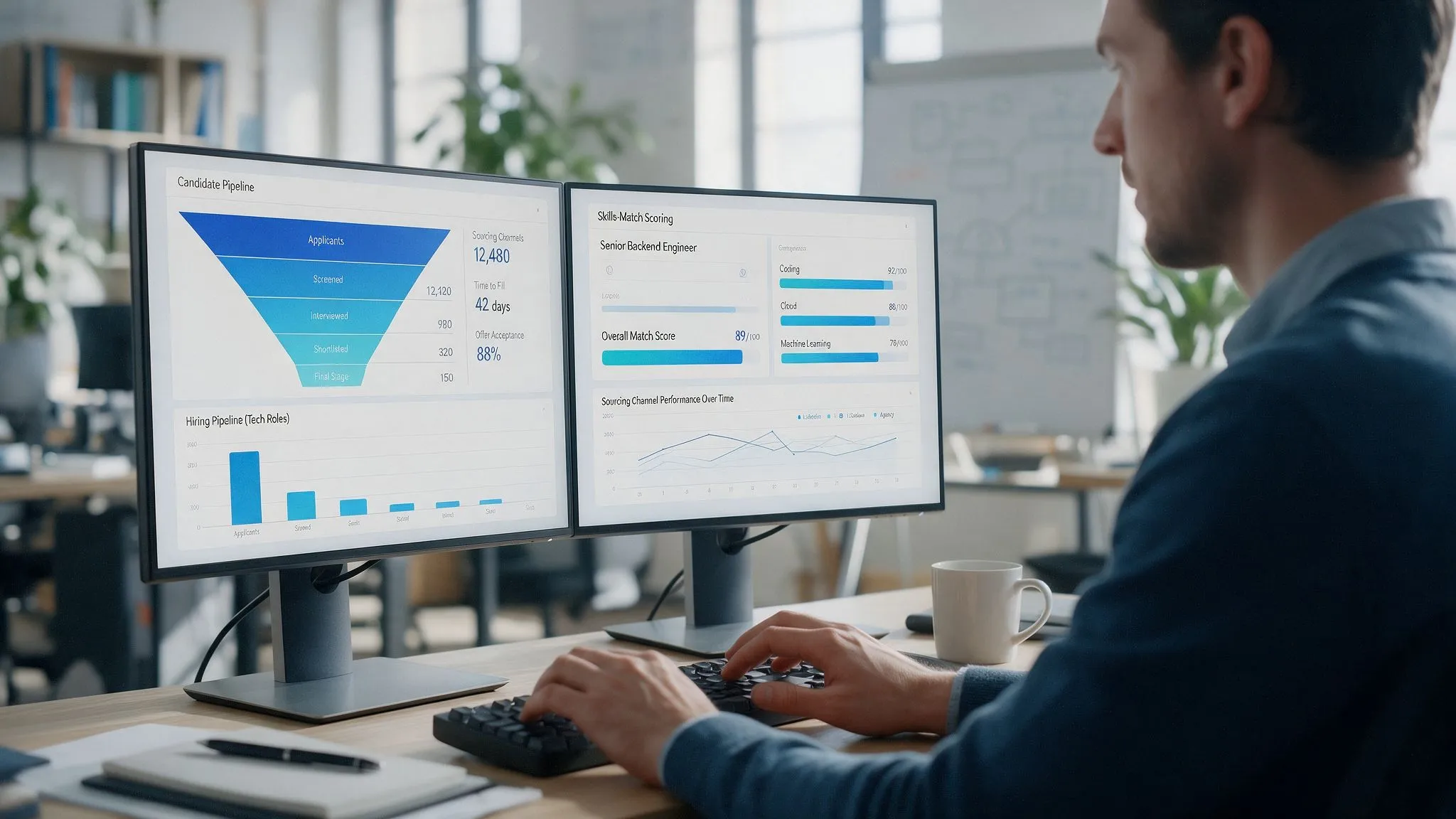
IT recruitment is one of the most competitive talent markets of any function. AI, ML, and cloud skills are in high demand, and the available pool of qualified candidates has not kept pace.
The window to engage a strong technical candidate is shorter than most enterprise hiring processes allow. Slow, credential-led processes lose good candidates to organisations that move faster and evaluate more precisely.
According to Robert Half's 2026 technology hiring analysis, AI, ML, and data science job postings grew 163% from 2024 to 2025. That growth has not been matched by an equivalent increase in qualified candidates.
Hiring intelligence is the framework that addresses this. This article covers what it is, how it works at each stage of IT recruitment, and what to look for in a platform.
Quick Summary
Hiring intelligence is the use of AI, data, and structured evaluation to improve how IT teams assess and select candidates. It replaces impression-based hiring with evidence that is structured, comparable, and traceable.
For IT recruitment specifically, this matters more than in most other functions. Technical roles are hard to fill, expensive to get wrong, and dependent on skills that resumes describe inconsistently.
What Is Hiring Intelligence?
Hiring intelligence means using AI, data, and structured evaluation to make recruitment decisions based on actual evidence rather than instinct.
It is not a single product or feature. It is a framework built on four connected capabilities, each addressing a gap that most recruitment processes leave open.
Predictive analytics identifies which candidates are most likely to succeed in the specific role, based on structured evidence rather than resume proximity.
Talent market intelligence gives recruiting teams a clear picture of where qualified candidates are, what skills are actually available, and how compensation benchmarks sit in the current market.
Process intelligence tracks where qualified candidates are dropping out of the pipeline and why, surfacing bottlenecks before they compound across an entire hiring cycle.
Decision intelligence turns evaluation data into clear, comparable insight so hiring decisions reflect what candidates actually demonstrated, not what panelists recalled afterward.
Together, these four capabilities help IT recruitment move from a process that resets with every search to one that builds on each one. This is a part of how AI is reshaping HR functions, with evaluation intelligence as one of the most active areas.
Why IT Recruitment Needs This More Than Most Functions
Every function benefits from better hiring. In IT recruitment, however, the conditions are specific enough that hiring intelligence is not just useful, it becomes necessary.
The accelerating shift toward skills-based hiring in IT is one signal of this. Skills-first hiring only works if the evaluation infrastructure behind it is reliable. Hiring intelligence provides that infrastructure.
Skills that resumes simply do not capture
Two candidates with different years of Python experience could be worlds apart in ability, or nearly identical. A resume rarely tells you which, and that is the core problem with credential-based screening in IT.
Most teams know this, yet the majority of IT evaluation processes still use credentials and job titles as the main filter.
Hiring intelligence offers a more reliable approach. It builds evaluation around the specific competencies each role requires and assesses every candidate against those consistently, regardless of their background.
The real cost of a wrong hire
A wrong hire at senior engineering level costs more than just the replacement salary. There are usually six to twelve months of onboarding, knowledge transfer, and reduced team output before things get back on track.
Any projects waiting on that role absorb the delay too. The next search usually begins under pressure, which rarely leads to a better outcome.
Hiring intelligence reduces this risk. Building evaluation on structured evidence from the start means the shortlist reflects actual capability, not interviewer impression.
Evaluation that breaks down at scale
An IT team filling 200 technical roles across multiple locations is not running 200 equivalent evaluations. Different interviewers apply different standards, different panels weight competencies differently, and the shortlist that emerges reflects that variance as much as actual candidate quality.
Hiring Intelligence addresses this by applying the same evaluation criteria across every session and location. When all candidates are assessed consistently, the shortlist reflects actual quality rather than which panel happened to review them.
How Hiring Intelligence Changes Each Stage of IT Recruitment
Here is how hiring intelligence changes each stage of the process. The shifts are specific and measurable, which is part of why HR automation now often includes evaluation intelligence alongside screening and scheduling.
Sourcing: from credential proximity to actual capability
Traditional IT sourcing tends to draw from familiar territory: the same companies, the same institutions, the same job title patterns. It is quick, but it often produces pipelines that look almost identical to the last one.
Hiring intelligence shifts sourcing toward demonstrated capability. Candidates are found based on what they can do rather than where they have worked, which opens up a wider and often stronger pool.
Screening: replacing volume with signal
The screening stage is often where good candidates get filtered out for the wrong reasons. Reviewing a large pool quickly pushes recruiters toward shortcuts: employer names, university, how a CV looks. The decisions are fast, but not always accurate.
Structured pre-screening replaces that with a consistent process. Every candidate answers the same questions, scored against the same criteria. The shortlist reflects how well candidates actually fit the role, not how well-presented their CV is.
Evaluation: from panel variance to structured evidence
Unstructured technical interviews are where evaluation quality tends to drop. When each interviewer covers different ground based on what interests them, the data that comes out is inconsistent and hard to compare across candidates.
Structured evaluation changes that. When every candidate is assessed against the same competencies and the same standard, the hiring manager gets a clear, comparable picture rather than a set of individual impressions based on different conversations.
Analytics: learning from every search
Most IT recruitment programs do not improve systematically between searches. Individual recruiters develop role-specific intuition over time, but that knowledge rarely transfers into the next search for the same profile.
Hiring intelligence produces structured data at every stage so those questions become answerable: which sourcing channels work best for this role type, where strong candidates are dropping out, and which evaluation criteria actually predict performance.
Over time, each search informs the next. That is the difference between a recruitment program that improves and one that simply repeats the same process.
What Hiring Intelligence Looks Like in Practice
Without hiring intelligence, filling a senior cloud architect role typically follows a familiar pattern: source from known networks, screen by CV, interview with varied questions, debrief from memory, and make a call based on overall impression.
With hiring intelligence, each stage works differently. Sourcing draws from a broader pool. Pre-screening produces a ranked shortlist. By the time a hiring manager sees a candidate, there is already structured evidence to work from.
The decision is based on evidence, not recall. Structured technical interview platforms make this possible by turning each session into a documented, comparable data point rather than an undocumented conversation.
At the evaluation stage, adaptive AI interview tools assess every candidate against the same competency framework, adjusting follow-up questions in real time and producing a structured capability report that writes directly into the ATS.
What to Look for in a Hiring Intelligence Platform
Not every platform that claims hiring intelligence actually delivers it. The following criteria help identify the ones that do. It also helps to understand what good AI recruitment software looks like before narrowing down options.
Role-specific evaluation depth is the first thing to check. A cloud architect evaluation and a data engineer evaluation should look different. If the platform applies the same scorecard to both, it is not assessing role-specific capability.
Structured, comparable output is the second criterion. Every assessment should produce something the hiring manager can compare directly across candidates. If the output needs to be interpreted differently for each candidate, it is not structured.
Native ATS integration is more important than it might appear. Evaluation data that lives outside the ATS has to be reconciled manually, and at enterprise scale that becomes a significant overhead.
Compliance documentation has become a standard requirement in enterprise procurement. Any AI platform used in structured hiring decisions should be able to provide bias audit documentation when needed.
Wrapping Up
Hiring intelligence is not about removing recruiters from the process. It is about giving IT teams the evidence they need to make better calls, and a process that gets better with each search.
For IT teams where candidates move quickly and evaluation quality directly affects outcomes, that shift matters. A slow process loses good candidates. An inconsistent one leads to poor hires. Hiring intelligence helps address both.
Zeko AI is built for enterprise and GCC IT recruitment teams. Avya, the platform's interview agent, conducts adaptive AI-led interviews, produces structured capability reports, and feeds the output directly into the connected ATS.
Zeko AI ensures full compliance with GDPR, SOC 2, and Indian DPDP requirements.
FAQs
1. What is hiring intelligence?
Hiring intelligence is the use of AI, data, and structured evaluation to make better recruitment decisions. It covers four areas: predicting which candidates are likely to succeed, understanding the talent market, identifying where the pipeline is losing strong candidates, and turning all of that into clear hiring recommendations.
2. How is hiring intelligence different from traditional recruitment?
Traditional recruitment relies on resume screening, credential matching, and impression-based interviews. Hiring intelligence replaces those with structured evaluation, skills-based matching, and pipeline analytics. The result is comparable evidence across every candidate, rather than a set of individual impressions that are hard to act on consistently.
3. Why does IT recruitment need hiring intelligence more than other functions?
IT recruitment has specific challenges. Skills are hard to assess from a resume. Senior mis-hires are expensive. Evaluation consistency across distributed panels is difficult to maintain. When combined with a tight talent market for AI and technical skills, those challenges make a strong case for structured, evidence-based hiring.
4. What are the four pillars of hiring intelligence?
The four pillars are predictive analytics, which identifies which candidates are likely to succeed; talent market intelligence, which informs sourcing with live market data; process intelligence, which shows where the pipeline is losing strong candidates; and decision intelligence, which turns all of that into clear, comparable recommendations.
5. How does structured interviewing support hiring intelligence in IT recruitment?
Structured interviewing applies the same competency criteria across every candidate and panel, so the output is consistent and comparable rather than dependent on individual interviewer judgment. This consistency is particularly important in technical hiring, where evaluation quality directly affects hire quality.
6. What should I look for in a hiring intelligence platform for IT teams?
The following four things matter most: role-specific evaluation depth, structured output that is comparable across every candidate, native ATS integration, and compliance documentation for enterprise procurement. A platform that cannot demonstrate all four is unlikely to be the right fit at enterprise scale.
Act Now
Build a Consistent, Audit-Ready Hiring Process
Standardize interviews across geographies and improve hiring quality with Zeko's AI platform.
Trusted by 150+ enterprises
SOC2 · GDPR · ISO27001
4.8/5 Average Candidate Rating
Act Now
Build a Consistent, Audit-Ready Hiring Process
Standardize interviews across geographies and improve hiring quality with Zeko's AI platform.
Trusted by 150+ enterprises
SOC2 · GDPR · ISO27001
4.8/5 Average Candidate Rating
Act Now
Build a Consistent, Audit-Ready Hiring Process
Standardize interviews across geographies and improve hiring quality with Zeko's AI platform.
Trusted by 150+ enterprises
SOC2 · GDPR · ISO27001
4.8/5 Average Candidate Rating